
Editorial Process
Kelajak International Group operates a rigorous and transparent editorial workflow designed to ensure the scientific integrity, fairness, and quality of all published manuscripts. All submissions undergo a double-blind peer-review process involving at least two independent reviewers, followed by a final editorial decision. The steps of the editorial process are outlined below.
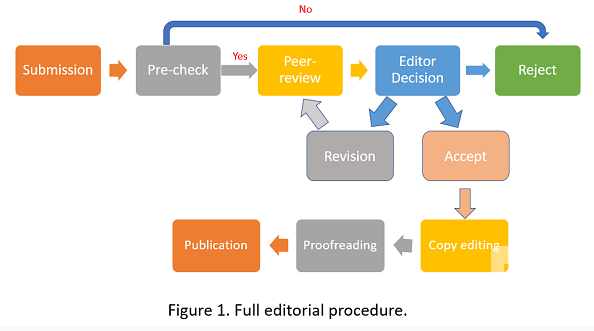
1. Initial Screening (Pre-Check)
Immediately after submission, each manuscript undergoes an initial evaluation by the Managing Editor or Editorial Office. This stage includes:
- Scope Check: Assessment of whether the manuscript fits the journal’s aims, scope, or special issue theme.
- Author Verification: Confirmation of the authors’ academic affiliation and background.
- Plagiarism Screening: All submissions undergo similarity detection using appropriate tools (e.g., iThenticate/Turnitin). Authors may be advised to revise duplicated text and add proper citations where necessary.
After completing the pre-check, the manuscript is assigned to an Academic Editor based on expertise and workload.
No Academic Editor will handle a manuscript if a conflict of interest exists with any of the authors.
If the Academic Editor determines that the manuscript is:
- outside the journal’s scope, or
- not of sufficient scientific quality,
it may be rejected at the pre-check stage without external review.
2. Peer Review
Each manuscript that passes pre-check is sent for double-blind peer review. At least two independent reviewers are invited to evaluate the submission. Reviewer selection is based on:
- absence of conflicts of interest;
- possession of a PhD or equivalent research experience;
- recent and relevant publications in the manuscript’s subject area.
Reviewers provide detailed reports along with a recommendation:
- Accept without revision
- Minor revision required
- Major revision required
- Reject (insufficient quality or novelty)
3. Editorial Decision
Once all reviewer reports have been received, the Academic Editor evaluates:
- reviewer comments,
- the scientific merit of the manuscript,
- the suitability of the article for the journal.
The Academic Editor may choose one of the following actions:
● Accept
If the manuscript requires no revisions, the Editorial Office performs a final technical check before notifying the authors of acceptance.
● Reject
If the manuscript does not meet scientific or editorial standards, the rejection is final and immediate.
● Request Revision
The authors are invited to revise their manuscript based on reviewer feedback.
Although reviewers provide recommendations, the Academic Editor makes the final decision and may disagree with reviewers when justified.
4. Revision Process
If revisions are required, authors must:
- submit a revised manuscript addressing all reviewer comments, and
- provide a detailed response-to-reviewers document.
The revised version may be:
- re-evaluated by the same reviewers, or
- assessed directly by the Academic Editor.
After reviewing the updated manuscript, the Academic Editor may:
- accept the manuscript,
- request further revisions, or
- reject it based on remaining concerns.
The manuscript is accepted once all issues have been satisfactorily resolved.
5. Online Publication
After acceptance:
- The manuscript is sent to the authors for final proofreading.
- The final approved version is formatted and scheduled for online publication.
- Once published, the article becomes immediately available in open-access format on the journal’s OJS platform.

KELAJAK INTERNATIONAL GROUP
Scholarly Open Access Publishing
Copyright © 2026 KELAJAK INTERNATIONAL GROUP LLC. All Rights Reserved.
Scholarly Open Access Publishing
Copyright © 2026 KELAJAK INTERNATIONAL GROUP LLC. All Rights Reserved.
GUIDELINES
FURTHER INFORMATION
CONTACT US
- Address: 23 Turon Street, Kokand, Fergana Region, Republic of Uzbekistan
- Email: publisher@kigpublishing.com, info@kigpublishing.com
- Phone: +998 (91) 684-81-85